Will Richardson

Speaker, consultant, writer, learner, parent

  • About
    • About Will
    • Testimonials
    • Contact Will
  • Blog
  • Speaking
  • Coaching
  • Books
  • BQI

A Broader Use for "Fair Use"

April 1, 2008 By Will Richardson

Important post from Joyce Valenza that should start some interesting thinking about Fair Use:

I learned on Friday night that the critical test for fairness in terms of educational use of media is transformative use. When a user of copyrighted materials adds value to, or repurposes materials for a use different from that for which it was originally intended, it will likely be considered transformative use; it will also likely be considered fair use. Fair use embraces the modifying of existing media content, placing it in new context. Examples of transformativeness might include: using campaign video in a lesson exploring media strategies or rhetoric, using music videos to explore such themes as urban violence, using commercial advertisements to explore messages relating to body image or the various different ways beer makers sell beer, remixing a popular song to create a new artistic expression.

Basically, Joyce writes about how the scope of what we can and cannot do with our students regarding reuse and remix of copyrighted materials may be much broader than we think. Read the whole thing.

Filed Under: Media Tagged With: education, fairuse, Media, teaching

The "Conversation" About "Conversations"

April 1, 2008 By Will Richardson

Lots of interesting and angst-ridden writing flowing around of late about the “conversations” happening in the edublogosphere, set off in some measure by a recent post by Doug Belshaw.

The edublogosphere has changed from being about ‘the conversation’ to being part of ‘the network’. It all smacks a little too much of ‘keeping up with the Joneses’ and, to be honest, viral marketing of Web 2.0 apps.

The comments thread holds flashes of all sorts of emotions: frustration, resolve, anger, intimidation. It’s one of the more compelling “conversations” that I’ve read recently and worth taking the time to sift through. John Larkin captures much of it, but centrally, he says “The conversations are limited to a few but cloned by many.”

Graham Wegner weighs in as well, taking a more expansive tact:

But there’s a lot of conversation out there – one can choose to connect to the visionaries and push for meaningful change or extend one’s global staffroom to gain support, inspiration and resources in equal measure. I tend to dabble in all camps on this blog anyway – no issue’s too big for me to have an uninformed go at and I want to improve what I take into the classroom tomorrow as well.

And then there was Doug Noon, compelled in some part by the “conversation” above to dive into Twitter after showing some resolve not to.

The interesting thing, and the thing that moved me to set up the Twitter account, was that with the Diigo stampede, Graham Wegner’s post about edublogging and the bigger conversation, this post about filtering Twitter so that it works more like Del.icio.us, and Miguel’s expansive vision for using Diigo to build a multipurpose networking application, I began to give some more serious thought to what seems to be a changing blogscape.

And, finally, there was Chris Craft in a short little dig in the comments on my “Tweaking Twitter” post where after reading that I was trying to filter out the links from my Twitter feed he asked simply “So what you’re saying is it’s about the links, not the conversation?”

I’ve always maintained, and still do, that the bulk of my learning these days comes in the conversation, that the publishing piece, the putting myself out there in a blog post (or video, or stream or whatever) is only the first step and, in reality, is not where I learn the most. I learn when my thoughts get pushed, when I read what others have written about other ideas on their own blogs, when I engage in the conversations about those ideas. And these “conversations” are different; they are not synchronous (though they are getting moreso), they are not linear, and as just the short sampling of link above conveys, there is a lot of complexity in the distributed nature of how we “talk” in this realm. In fact I think that might be the biggest frustration that newcomers to these tools experience. It’s random, seemingly aimless, and requires a whole bunch of other skills to navigate effectively.

And now, the conversations are morphing further. There are more voices. While it’s humbling to get 160 comments on a blog post, is it better? Now I have 300 Tweets a day to make sense of, and talk about raising the frustration level. What do you do when a Tweet comes by that say “@whoever45 I am so, so sorry to hear that! What can we do?” Or “@whoever 36 Great link! Thanks!” No context. No thread to speak of. The “conversation” has to be remanufactured, or in many cases, simply let go. And Twitter just feels like the bridge between true asynchronous dialogue and the emerging, constant backchannel that crops up on streams and at Chatzy during presentations, pushing the “conversation” further. To be honest, I think I’m most off put by the backchannel not because it can be a distraction to whatever it is we’re backchannelling about but because it totally strips the reflective, thought mulling-over part from the “conversation” process.

Guess I’m getting a little angsty myself.

Doug links to a Wired post by Bruce Sterling who quotes Stowe Boyd, and his assessment doesn’t make me feel any better.

Basically, conversation is moving from a very static and slow form of conversation — the comments thread on blog posts — to a more dynamic and fast form of conversation: into the flow in Twitter, Friendfeed, and others. I think this directionality may be like a law of the universe: conversation moves to where is is most social…The way I am getting tugged to blog posts is increasingly as a mention within a conversational bite in Twitter or Friendfeed. I then click out of the flow to see the larger post, and offer my view in the flow — not on the blog — and then I return to the flow, where I will be spending most of my time. This makes sense: I want to talk about the blog post with the person who brought it to my attention, more so that with some group of strangers at the blog, or even the author, who I may not know at all. I also don’t think we can expect the fragmentation of the social experience to slow down: it will get a lot worse before it gets better.

Funny thing is, I like the stranger’s voice. Doesn’t that sound like it just perpetuates the echo chamber we all seem to be trying to get away from?

At the end of the day, I’m just flailing around in here like the next person trying to see how if all makes sense for myself and for my own children. The conversations are shifting, both in form and content. In the process, it gets more challenging to help others make some sense of it for themselves. But I wonder as we continue to spend more of our online conversation time in the moment if we aren’t losing much of the value that the potential of conversation with these tools can bring.

To me, it’s about both the conversation and the network. I depend on the network connections I have to filter and find and share and provoke, but without the deeper conversations among the nodes in that network, it’s feeling like the connections lose value.

(Photo “Flowing Systems” by  exper)

Filed Under: On My Mind, The Shifts Tagged With: blogs, education, networks, shifts

Teachers Walking Out? Students Got it Covered.

March 30, 2008 By Will Richardson

So what do you do if you are a student in Nashua, NH and along with your community, you’re staring a teacher walkout in the face?
Well, you put together a whole slew of Read/Write Web tools and get ready to cover the event, everything from a Facebook group to a video channel to a blog. Here is the deal according to the Facebook page:

A team of students from both Nashua High Schools, skilled in video production, computer editing, webcasting, and Internet social networking have established an off-campus production center to keep the community informed, moment-to-moment, in the event of a Nashua Teacher’s Union job action. The student center will webcast daily, upload video interviews and other footage constantly. The team will employ video chat, instant messaging, and social networking activity through sites such as Facebook to keep in touch with their audience.

And the kids seem to get what the possibilities are:

“What people don’t see is how this situation is impacting the students.” said Korey O’Brien, producer. “We have first amendment rights, and as citizens in a democracy have an obligation to get involved.” O’Brien believes that students can be objective: “Given the extreme opinions on both sides that I’ve read about in the newspaper, it should be easy for us to offer a more reasonable viewpoint. If we broadcast the student’s perspective, perhaps our voices will affect how the issue is resolved.”

They’ve got over 230 members in the Facebook group since Thursday, a half a dozen videos up already, and according to Nicole Tomaselli who sent me the link, they’ve got quite a following already.

The Nashua teachers have been modeling the uses of these tools for quite some time. I’ve had a link to their YouTube channel on my presentation wiki for over a year now. (Check out this video from their “Education Worth Paying For” series.) I have no idea if these kids have been “taught” to use these tools for the intended purpose or if they’ve recognized it on their own, but I think this is an amazingly cool example of kids doing real work for real audiences, the same audiences which will, in the end, assess the effectiveness of their work.

So where is this in your currciulum?

Filed Under: Social Stuff, The Shifts Tagged With: education, nashua, students, teaching

Starting Point for Schools: Articulation

March 26, 2008 By Will Richardson

Yesterday I had the pleasure of spending four hours in Elluminate with Sheryl and a dozen or so of the schools that we’re working with from the Southeastern states for PLP holding a “work session” around the culminating projects they’ll be presenting next month. And though I know the idea of spending four hours doing anything online is overwhelming for a lot of folks, I do mean it when I say “pleasure.” Their projects, by and large, blew me away in terms of their scope and thoughtfulness, and it was apparent that most of them were really beginning to understand the network creation and expansion part of this. And it was great to see the extent to which these ideas seemed to be taking hold in their schools. (We’ll be sharing these out down the road.)

But while it wasn’t a central focus of most of the projects, for some reason what’s really stuck in my head are the conversations we had about those that revolved around using these technologies for articulation. And the more I thought about it, the more natural a starting point it seemed for schools who are trying to adopt (or adapt to) these technologies. I’m often struck by how many times I hear about the lack of communication, the isolation of teachers, the inconsistency of the teaching and pedagogy in schools and districts. And those are all things that teachers lounges and monthly department meetings can’t really assuage.

I know it would require some front end loading, but if districts were using wikis to house curriculum and encouraging teachers to work off of them as they move through the year, noting, tweaking, fine tuning, reflecting, etc., it would be one way that they could begin to make good use of a Web 2.0 tool and make it easier to connect to what other folks are doing. Not to mention the growing of some very important local network connections (which then, of course, could be expanded out.) And the other piece, of course, is that it’s a “safe” way to get started at least in terms of not having to deal with student participation issues.

And when you think about it even for just a few seconds longer, it’s not hard to come up with all sorts of other ways to create a rich curriculum “text” if you will that could include videos of lessons, links to resources and artifacts, and the general throwing around of ideas that could potentially deepen the impact of what’s happening in the classroom.

Or not. There is the time issue, the buy in issue, and other issues. But I’m sure there are some good examples of this already out there, aren’t there?

Filed Under: Wikis Tagged With: articulation, education, Wikis

The Future of the Internet and How to Stop It

March 25, 2008 By Will Richardson

I had the great pleasure of listening to Jonathan Zittrain the two years that I attended I-Law at Harvard (an event that unfortunately is no longer being held.) Going back and reading this post from four years ago just now reminds me just how far all of this has come and, more dishearteningly, how little has really changed. (i.e. “And right now, while kids by and large have the technology skills to create, they have very few models for appropriate uses for that creation.” Oy.) I will always remember those two sessions as among the most amazing and interesting learning days of my life, hugely validating and compelling on all sorts of levels.

No doubt, it’s one of the reasons I still perk up when Lawrence Lessig or Yochai Benkler or the rest publish books or articles or interviews. And so when I saw that Zittrain was publishing a book, I pre-ordered from Amazon and got it this week. While I’m only a few pages in to it, the point is clear: we are at a critical point in the evolution of the net, one where we are faced with some not so great scenarios of abuse and control that are going to require some level headed thinking and action to navigate. Here is the thesis:

In the arc from the Apple II to the iPhone, we learn something important about where the Internet has been, and something more important about where it is going. The PC revolution was launched with PCs that invited innovation by others. So too with the Internet. Both wer generative: they were designed to accept any contribution that followed a basic set of rules (either coded for a particular operating system, or respecting the protocols of the Internet.) Both overwhelmed their respective proprietary, non-generative competitors, such as the makers of stand-alone word processors and proprietary online services like CompuServe and AOL. But the future unfolding right now is very different from this past. The future is not one of generative PCs attached to a generative network. It is instead one of the sterile appliances tethered to a network of control (3).

I’m not sure yet how much this parallels the lock down vs. open up choice that schools are facing right now, but I have a feeling the conversations will parallel in many ways. (There is only one page referenced in the index to schools.) More as I dig through. And, just a off the top thought, but if anyone wants to do a book club, let me know.

Filed Under: Books Tagged With: education, future, internet, technology, zittrain

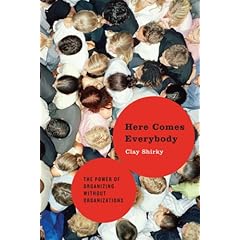
Here Comes Everybody

March 21, 2008 By Will Richardson

Finished Clay Shirky’s “Here Comes Everybody” yesterday and it’s now on the top of my list in terms of books that explain the state of the world in a cogent, balanced, even-tempered way. It’s not a book about education, per se, but it’s a book by an educator who brings a teacher stance to the conversation. And it articulates clearly and without hyperbole the shifts and challenges that are presenting themselves right now.

Before getting to some of the more salient quotes, let me just say that I’m feeling a great deal more urgency about this conversation at the moment. Between reading the book and watching some of the videos from the FastForward blog on the future of enterprise, it just feels like the tsunami is bearing down on us and we don’t even know there’s much of a wave out there on the ocean. (Take a few minutes to watch this vid interview with John Hagel, for instance. How are we as schools developing “talent”?)

Early in the book, Shirky makes the point that while traditional institutions are facing competition, they are not going away. But they are going to have to change:

None of the absolute advantages of institutions like businesses or schools or governments have disappeared. Instead, what has happened is that most of the relative advantages of those institutions have disappeared–relative, that is, to the direct effort of the people they represent (23).

The value of the services that institutions provide is changing as individuals become more and more able to undertake “ridiculously easy group forming” and do everything from share music to create the sum of human knowledge online. That ability is what changes the rules, Shirky says, and that can be a good thing (Wikipedia) and a bad thing (terrorists). But it is profound, nonetheless.

We are plainly witnessing the restructuring of the media businesses, but their suffering isn’t unique, it’s prophetic. All businesses are media businesses, because whatever else they do, all businesses rely on the managing of information for two audiences–employees and the world. The increases in the power of both individuals and groups, outside traditional organizational structures, is unprecedented. Many institutions we rely on today will not survive this change without significant alteration, and the more an institution or industry relies on information as its core product, the greater and more complete the change will be (107). [Emphasis mine.]

Which says a couple of things to me. First, we need to move away from this idea (as driven by current assessments) that information is our core product and that second, we need to set information free in our schools. If we don’t, how will we ever be able to teach our kids how to use well the power they can now wield with their networks?

Shirky also points out that this is not going to be fast nor will it be easy.

As with the printing press, the loss of professional control will be bad for many of society’s core institutions, but it’s happening anyway. The comparison with the printing press doesn’t suggest that we are entering a bright new future–for a hundred years after it started, the printing press broke more things than it fixed, plunging Europe into a period of intellectual and political chaos that ended only in the 1600s (73).

I wonder, however, if time runs at the same speed today as it did back then. 100 years feels like an awfully long time for all of this to shake out.

There is much more to think about here, but I’ll end where Shirky ends, with some thoughts on how we first have to change our own frames before any of this will begin to truly make sense. Apologies for the long snip, but I think it’s worth the read:

For us, no matter how deeply we immerse ourselves in new technology, it will always have a certain provisional quality. Those of us with considerable real-world experience are often at an advantage relative to young people, who are comparative novices in the way the world works. The mistakes novices make come from a lack of experience. The overestimate mere fads, seeing revolution everywhere, and they make this kind of mistake a thousand times before they learn better. But in times of revolution, the experienced among us make the opposite mistake. When a real once-in-a-lifetime change comes along, we are at risk of regarding it as a fad.

…young people are taking better advantage of social tools, extending their capabilities in ways that violate old models not because they know more useful things than we do but because they know fewer useless things than we do. I’m old enough to know a lot of things just from life experience. I know that newspapers are where you get your political news and how you look for a job. I know that music comes from stores. I know that if you want to have a conversation with someone, you call them on the phone. I know that complicated things like software and encyclopedias have to be created by professionals. In the last fifteen years I’ve had to unlearn every one of those things and a million others, because they have stopped being true. I’ve become like the grown-ups arguing in my local paper about calculators; just as it took them a long time to realize that calculators were never going away, those of us old enough to remember a time before social tools became widely available are constantly playing catch-up. Meanwhile my students, many of whom are fifteen years younger than I am, don’t have to unlearn those things, because they never had to learn them in the first place.

The advantage of youth, however, is relative, not absolute. Just as everyone eventually came to treat the calculator as a ubiquitous and invisible tool, we are all coming to take our social tools for granted as well. Our social tools are dramatically improving our ability to share, cooperate and act together. As everyone from working biologists to angry air passengers adopts those tools, it is leading to an epochal change.

Read the book.

Filed Under: The Shifts Tagged With: books, clayshirky, education, shifts

An Education President

March 19, 2008 By Will Richardson

Like him or not, what Barack Obama did yesterday, in my opinion at least, epitomizes what we need our next president to be, namely a teacher. Agree with him or not, can there be any doubt that anyone listening to that speech yesterday is not thinking harder and more expansively about race in this country and in our lives today? Trust him or not, is there any question that he articulated a real truth about the state of race relations from both a black and a white perspective?

Right now, we are having a “teachable moment” about race in America. If you listen to conservative talk radio as I have been for the past few weeks, the issue is, no pun intended, black or white. If the candidate does not distance himself from his pastor and his church, then he is guilty by association of believing the invective that’s being dragged in front of us by the media or which we are choosing to consume on YouTube. If he does distance himself, then it’s simply politics as usual. It’s a simple equation.

But the reality is that this conversation, like most, is more nuanced. And it’s our collective lack of understanding of that nuance which bogs us down. We have little empathy for the experiences of those unlike us, and too many of us are afraid to ask. We need an education in this country about race. We need a starting point for the conversation, and we need someone to take on a teacherly role to guide it.

Seventy-five years ago, FDR gave the first of his “Fireside Chats” intended to educate (as well as sway) the American public about the issues of the day. By every measure, they were hugely successful in moving people to act in informed and collective ways. And the feedback that Roosevelt received in the form of millions of letters allowed him to tap into the pulse of the people and the nation in ways that few other presidents before or since have been able to. He guided, he taught my father’s generation about the realities of the world, enabling them to have more informed conversations about the state of their lives. Yes, I know, these were not balanced presentations, but at minimum they made the country think about the proposed solutions to the complexities of the time.

And while the world by its very nature is complex, this moment seems decidedly so. Not just because of race, but because of the litany of problems that Obama articulated and the fact that no one no matter what color or heritage is immune from them. (I don’t think climate change cares much about the color of your skin or your family heritage.) We need someone who will encourage and facilitate a broad ranging conversation about these issues. We need someone who can create some lesson plans for the millions of us who want to engage, want to contribute, want to work to solve the problems together. We need someone who I can hold up as a role model for my own children as a steward for the environment, as a peace maker, as a listener, as a deep thinker.

We need a teacher.

This is just one of many teachable moments that this world and this society will continue to throw at us. Rare has been the occasion when we as a country have been led to a deeper understanding of events. In what was without question the most teachable moment of my life six-and-a-half years ago, I was told to go to the mall and keep spending my money. That’s not what a teacher would have done.

To steal from the inimitable Chris Lehmann, yesterday, I saw a teacher.

Filed Under: On My Mind Tagged With: education, obama, politics, teaching

On "Infovores" and "Infofighters"

March 17, 2008 By Will Richardson

My aggregator is piling up and I’m in one of those “no-time-to-read-my-feeds” stretches, especially when I get a new book in my hands that really makes me think. Clay Shirky’s “Here Comes Everybody” is probably about the most level headed deconstruction of what’s happening with the Web that I’ve read yet, and, while it’s not nearly as sexy as Pink or Friedman, so far it’s pretty brilliant and much more grounded. He’s one educator who “gets it” in a very measured way. I’ve been marking it up like crazy and want to revisit a lot of it before I attempt some longer thoughts here, but there was one section that connected for me when I somehow landed on “Why We’re Powerless to Resist Grazing on Endless Web Data” from the Wall Street Journal last week.

In short, the article says that neuroscientists are finding evidence that we are addicted to new information, and in an era where new information is everywhere, that can be a problem:

In other words, coming across what Dr. Biederman calls new and richly interpretable information triggers a chemical reaction that makes us feel good, which in turn causes us to seek out even more of it. The reverse is true as well: We want to avoid not getting those hits because, for one, we are so averse to boredom. It is something we seem hard-wired to do, says Dr. Biederman. When you find new information, you get an opioid hit, and we are junkies for those. You might call us ‘infovores.’ ” For most of human history, there was little chance of overdosing on information, because any one day in the Olduvai Gorge was a lot like any other. Today, though, we can find in the course of a few hours online more information than our ancient ancestors could in their whole lives…We are programmed for scarcity and can’t dial back when something is abundant.

Hmmm…Twitter like opium, huh?

Believe it or not, I can relate to that “junkie for new information” description. (No, really.) And I really like that term, “infovore”. Definitely works. And it adds another layer to the whole balance issue. If we really are addicted to this, what does that say about how we teach our kids?

Shirky comes at it from the “creator of new information” stance and supplies a nice brain hit as well. In a chapter titled “Personal Motivation Meets Collaborative Production,” he talks at length about what makes Wikipedia work, that it’s more than simply a desire to work together. In fact, he says, Wikipedia “exists not as an edifice, but as an act of love.”

Wikipedia exists because enough people love it and, more important, love one another in its context. This does not mean that the people constructing it always agree, but loving someone doesn’t preclude arguing with them… What love does for Wikipedia is provide the motivation both for improvement and defense (141).

And it’s that last part where the info opiates kick in for me. The reason that vandals fail on Wikipedia is

because Wikipedia as a tool provides them with the weapons to fight those groups. Those weapons are taken up only by people who are willing to fight. Were that willingness to fade, the most contentious articles in Wikipedia, the articles on abortion and Islam and evolution, would be gone within hours, and it’s unlikely that the whole enterprise would survive a week (141)

And finally, there is this concluding paragraph to the chapter:

We don’t often talk about love when trying to describe the public world, because love seems to squishy and private. What has happened, though, and what is still happening in our historical moment, is that love has become a lot less squishy and a lot less private. Love has a half=life too, as well as a radius, and we’re used to both of those being small. We can affect the people we love, but the longevity and social distance of love are both constrained. Or were constrained–now we can do things for strangers who do things for us, at a low enough cost to make that kind of behavior attractive, and those effects can last well beyond our original contribution. Our social tools are turning love into a renewable building material. When people care enough, they can come together and accomplish things of a scope and a longevity that were previously impossible; they can do big things for love (142).

I know…quite a Kumbaya moment. But he’s right. Wikipedia was simply not possible before. So much more is possible today and will be possible for my kids, and I want them to feel the love, not just of learning new things, but of doing new things as well.

Filed Under: On My Mind Tagged With: clayshirky, education, information, learning

Students Pay a Price (Literally) for Cell Phone Ban

March 13, 2008 By Will Richardson

Yesterday, I had the real pleasure of spending some time in a 9th English classroom again, this time with a group of students from an under achieving, 3,000 pupil high school in midtown Manhattan. Ostensibly, I was there as a tag team with Alan November talking to city technology liasons and support teachers about the changes and challenges we’re facing, so while Alan spoke, I visited kids and vice versa. (I UStreamed the last 20 minutes or so of a Q & A that we did at the end of the day. Not great in terms of audio an video, but some good Alan rants.)

Anyway, the kids were the highlight. We talked about the technologies they used, how they used it, and what they might use it for, and the conversation was fairly predictable. Many of them had a decent Internet connection at home, but many had none. Despite that, they guessed almost 90% of the school had MySpace pages, that they went there every day, that they used it to communicate and get information about homework, and that, of course, it was blocked in school. (MySpace is blocked in NYC schools to everyone, even administrators. Ironically, up until a phone call was made on my behalf yesterday, this blog was also being blocked as a “social networking” site. Oy.) Surprisingly, (or maybe not so surprisingly) they seemed amazed at the idea that their sites would be looked at by employers or by colleges, and they seemed never to have thought about the idea that they would be Googled by their future mates. (And that they would be doing some Googling as well.) Now that was a moment.

Almost all of them had cell phones as well, phones which are banned in school. (The policy is that if you are caught with a cell phone in school, it’s taken away and it can only be returned to a parent who comes to pick it up on a Friday.) I hooked most of them when I took out my phone and had them ask me a question that they thought I wouldn’t know, which after a few more colorful attempts ended up being “What’s the population of Spain?” They watched as I sent a text message “Spain population” to 46645 (GOOGL) and get the answer back about 10 seconds later. Amazement ensued.

I told them I was a cell phone is schools advocate, and we talked about what they might say in making a case for a policy change. (The teacher was very ok with this, btw.) Since many of these kids commuted from over 30 minutes away by subway each day, almost to a person they said they needed their phones in case of an emergency. But when I nudged them past the safety issue, they talked about using the phone to make movies, to do interviews, even to write, (which surprised me until I learned Sidekicks were all the rage.) And, now, they said, for research. We talked about the “appropriate behavior” piece of this, that, just like with MySpace, there is an appropriateness issue here, that they would have some real responsibility on their shoulders should the phones ever be allowed. By and large, I was impressed by the way they made the case.

But here was the moment that floored me. Obviously, these kids don’t leave their cell phones at home. They are too important as a communications tool for safety’s sake and for social connections. Yet they can’t get these phones through the airport like scanners at the front of the building. So what do they do? Seems a little cottage industry as sprung up at the delis and bodegas around the school so that kids can check their phones in for the day at $3 a pop. They get a ticket, just like a coat check, on their way into school, and they pick it up on the way out.

Amazing.

So, the cell phone ban not only denies students the opportunity to use the device in all sorts of ways that are relevant to learning, it also costs them real money. Start doing some math, and it’s not hard to get to the answer that this high school’s kids are out hundreds of thousands of dollars a year just to check their phones. Hundreds of thousands of dollars.

To me, this is the vision thing again. In a school where there are about 300 computers for 3,000 students, doesn’t it make more sense to get creative about not only how we might use phones in the classroom but teach phones and phone use in the curriculum? I mean, are the economies worth working toward a solution of the “disruption” problem? And I’m sorry, but I just believe that if we show kids from an early age the appropriate and effective use of the technology, if we make it a valuable and necessary part of the way they do their school business, the widespread disruptions will abate.

End of rant. (Doing a lot of that lately.)

I do want to end this on a positive note. I started a UStream show with them, and thanks to Twitter, within a few minutes had about 20 folks from around the world (Canada, Romania, across America). They were blown away. I asked them what they thought they could do with UStream for themselves, and immediately they were talking about cooking shows, news broadcasts, and much more. They. Were. Engaged.

(Photo “Cell Phone Camera” by  L-ines.)

Filed Under: On My Mind Tagged With: cellphone, education, learning, schools

Many Voices for Darfur Project

March 4, 2008 By Will Richardson

From our good friend Mr. Mayo, who with Wendy Drexler has come up with another great project to participate in:

For 48 hours, starting at midnight Eastern standard time on March 6, 2008, many student voices will be collected in the name of those suffering in Darfur. Be sure that your voice is among them.

Men, women, and children in the Darfur region of Sudan are dying. The Sudan militia and Janjaweed are responsible for as many as 500,000 deaths and 2,500,000 displaced refugees. You can learn more about the genocide taking place in Darfur by visiting the Many Voices for Darfur Wiki. Once you have had a chance to learn more about Darfur, please post your comment to one or more of the following prompts below:

  1. If you could visit the camps in Chad and sit down one-on-one with a refugee who is your age, how would you explain what you or others are doing in your country to spread awareness and make a difference?
  2. Write an open letter to Omar al-Bashir pleading your case for the Darfur region of Sudan.
  3. Write an open letter to leaders in your country to make a case for government support of international efforts in Darfur.

Tell your friends!

Filed Under: Classroom Tagged With: collaboration, darfur, education

Out of the Box Thinking About Education and Teaching

January 2, 2008 By Will Richardson

So Leigh Blackall points to “The Personal MBA“, a “pdf version of a pay for text that guides people through an equivalent curriculum to a MBA.” It’s basically a reading list of all sorts of good stuff, from George Leonard’s “Mastery” (which I really need to read again) to “The Art of the Start” by Guy Kawasaki. It’s billed as an experiment in educational entrepreneurism, a way to save about $100,000 and still get the knowledge you need to succeed in business. Does it work? Well, I think the better question is “Can it work?” And to that, I would say, absolutely. Yes.

As Leigh points out, it won’t just work by reading the books in isolation. You’ll probably get a lot smarter, but you need the conversations and connections that the expensive MBA offers as well. So, Leigh says, leverage the social technologies we have at hand:

Enter a networked learning model to support this text perhaps. A way for people who are using this text to make contact and communicate about their efforts. Clearly the information doesn’t change all that much, but the packaging (and the fees) change considerably.  Is this the niche that traditional education ought to be looking at more closely? I think so.

I think so too. I don’t think there is any doubt that it is possible if you are motivated to learn and have the network building and organizing skills to pull it off. And it doesn’t hurt when the guys putting out the free curriculum build a site around it where folks can connect. As I know I say here a lot, we can build our own classrooms, find our own teachers, writing our own flexible texts and curricula as we go. Right now, everyone still gets hung up on the creds, I know. But we’re already seeing disruptions in that thinking. In this world, what you can do is a better assessment of what you know.

On a similar note, I’ve been struck by the mostly inside the box thinking about teaching and classrooms that’s been running through the responses on my recent post and on Clay’s post that spurred it. There are passionate defenses of teaching and classrooms and the importance of being with kids, all of them absolutely genuine and valid. For instance, Mark Ahlness says:

But this is what keeps me going: The 9:00 bell. That’s when the kids come in the door. Thank goodness for the kids. There, I’ve said it again…But that 9:00 bell keeps ringing. For one year my kids and I will have an incredible experience. Nobody can take that away from us, and my kids will remember.

I know a lot of teachers feel like that. I used to feel like that when I was teaching. The presence of Mark and others like him in our kids lives will always be important. But here is the thing. In the midst of the quote above, Mark writes:

Yes, it kills me when I see dysfunction in my educational system. Yes, it breaks my heart when I see 4th and 5th graders not using, and losing, the incredible tech skills they had in my classroom. Yes, it is incredibly frustrating when absolutely nothing I have tried in over a decade of encouraging technology use with my colleagues has made a bit of difference.

What jumps out at me here and many of those other responses is that despite what the system takes away from good teaching, few write about teaching as if it is something that can be done just as meaningfully outside of the system. That’s obviously what Clay is struggling with. And it’s what my brain continues to be chewing on. How can we start to think differently about teaching? How can we teach in meaningful, important ways outside of the current construct? How can we give good teachers the opportunity to teach without the inconsistencies and constraints of the system? And how do we do it in ways that can still serve all of the kids the system currently serves?

That last one is the really tough one…

(“Group Failure” by Cold Cut)

Technorati Tags: teaching, education, schools, learning

Filed Under: The Shifts Tagged With: education, learning, schools, teaching

The Kids are All Right…

December 7, 2007 By Will Richardson

Alec Couros’ post on digital citizenship makes some valid points, but I’m not convinced that a few examples of really vile content and lazy practice are reasons to think that the concept of citizenship is in some way fundamentally shifting. But I also don’t fall all the way to the Tom Hoffman side of the fence that says citizenship is little more than what many (though not Tom) would call information literacy.

What rings most true, however, was Stephen Downes’ comment about Tom’s post where he says, simply,

The vile content – and it most certainly is vile – is neither new nor original. And it’s not the kids that are creating it.

The fact is that we have been conditioned to see the worst at the expense of the best, primarily by a media that is always on the lookout for the lewdest, awfulest, stupidist behavior of our cultural icons. A media that then inculcates a connection between crass insignificance and news. And, perhaps to that extent at least, Tom is right. If we teach ourselves and our kids to simply stop and use these “five habits of using one’s mind well,” we’ll get a long way down the citizenship road.

  1. How do we know what’s true or not true? How credible is our evidence?
  2. Is there an alternate story? Perspective? How might this look from another viewpoint?
  3. Is there a connection between x and y? A pattern? Have I come across this before?
  4. What if… supposing that…? Could it have been otherwise if x not y had intervened?
  5. And finally, “who cares”? Does it matter? (And, perhaps, to whom?)

Especially the last one.

But I also believe that citizenship suggests more than critical thinking. It requires participation and action. It requires contribution. And the ways in which even our kids can contribute in this environment and the global scale those contributions now have do change the equation. And most importantly, let’s not forget that a lot of kids are creating and contributing and participating in ways that should make us very proud. For instance:

A ten-year old girl in upstate New York who starts a blog Twenty Five Days to Make a Difference that in just a week’s time has caught the interest of a whole bunch of kids from around the world who want to make a difference too.

Or the imminent launch of a network of student bloggers from around the world:

Students 2.0 Launch Teaser from Sean on Vimeo.

Or, though it’s not directly related to kids, the uber alternative to vile (religious music aside):

(Add your own examples below…)

Point is, there is a lot of good stuff out there too. And not that that fact is new or original, but there are a lot of kids who are doing it, and in the process, learning citizenship. And at the end of the day, if we really want to help our kids become good citizens themselves, the best we can do is to use our own minds well and model our own participation wherever and whenever we can.

Filed Under: Networks, On My Mind Tagged With: citizenship, education, literacy

  • « Previous Page
  • 1
  • …
  • 16
  • 17
  • 18

Recent Posts

  • “Never”
  • My 2023 “Tech Cleanse” Has Begun
  • Five Themes for Educators in 2023
  • Schools in a Time of Chaos
  • Has This Crisis Really Changed Schools?

Search My Blog

Archived Posts

Copyright © 2026 Will Richardson · All Rights Reserved

Follow me on Twitter @willrich45